
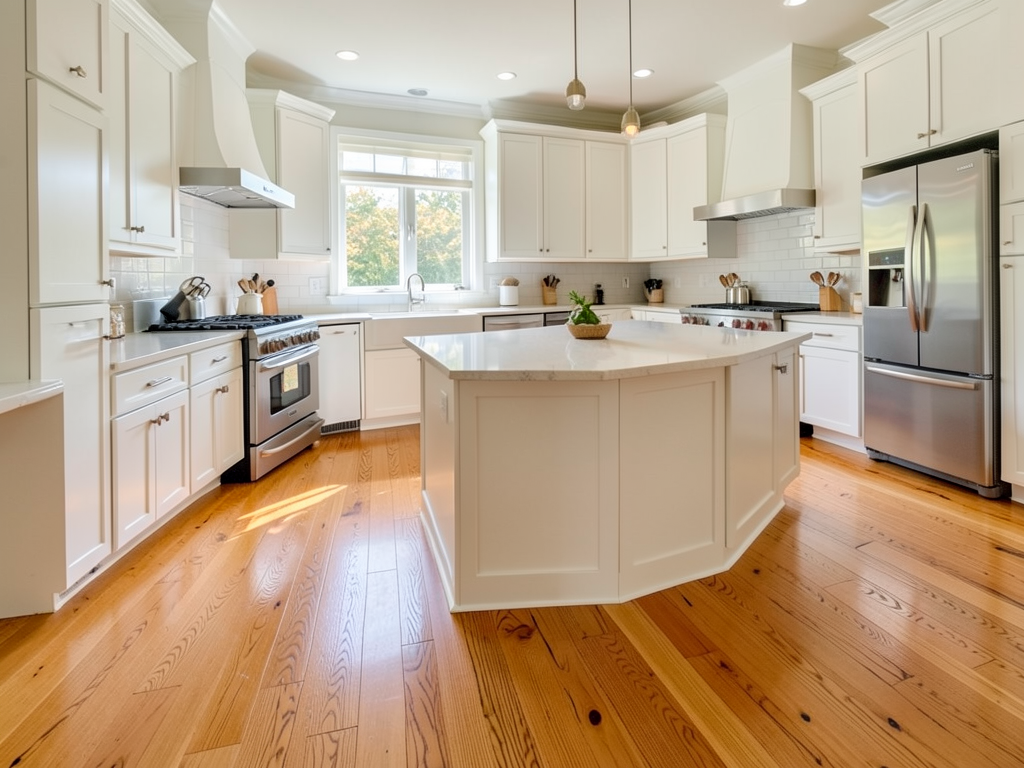
Hardwood Kitchen Floors in Metro Detroit Homes
A hardwood kitchen floor in a Metro Detroit home is one of those upgrades that changes how a house feels — and with the right species, finish, and installation method, it holds up beautifully for decades. From the bungalows of Ferndale to the colonials of Troy, the historic Tudors near Grosse Pointe, and the newer builds out in Novi and Canton, homeowners keep asking the same question: can wood really survive spilled juice, a leaking dishwasher, dropped knives, and Michigan's wild humidity swings? The short answer is yes. The longer answer is what this guide is about. Al Havner and Sons Hardwood Floors has been installing, sanding, and finishing wood floors across Metro Detroit for five generations, and we have seen exactly what works in a kitchen — and what quietly fails two winters later.
Why Metro Detroit Kitchens Are a Tough Test for Any Floor
Kitchens combine almost everything a wood floor dislikes: standing water near the sink, grease in the air, heavy foot traffic, pet bowls that slide across the surface, and rapid shifts in humidity. Add Southeast Michigan's climate — humid July afternoons, dry February air pushed through a forced-air furnace — and you have a room that punishes shortcuts.
That is not a reason to default to tile or vinyl. It is a reason to choose the right wood, the right finish, and an installer who understands how wood behaves in this specific climate. A floor that is properly acclimated, properly fastened, and properly finished handles a busy kitchen without drama. A floor that is rushed does not.
Humidity: The Invisible Culprit
Wood is hygroscopic, which means it takes on and releases moisture as the air around it changes. In a Michigan kitchen, indoor relative humidity can swing from the low 20s in January to well over 60 percent in July. Every one of those swings causes boards to expand and contract slightly across their width. When there is nowhere for that movement to go — a floor jammed tight against cabinets, a nailed-down floor over a damp subfloor, or a finish that has cracked and let moisture in — you get cupping, gapping, and squeaks.
The good news: experienced installers plan for that movement. Expansion space at the perimeter, correct fastening schedules, and moisture testing before the first board goes down are what keep a kitchen floor flat through ten Michigan winters.
Solid vs. Engineered Hardwood in the Kitchen
This is the single most important decision for a kitchen project, and the answer is not the same for every home. Our team walks through it with every customer before a single plank is ordered.
Solid Hardwood: The Traditional Choice
- Timeless look and refinishability. Solid oak, maple, or hickory can be sanded and refinished many times over its life — a real advantage in a kitchen that sees heavy use.
- Great for above-grade kitchens. Solid wood performs best over a stable, dry subfloor on the main level of the home, which describes most kitchens in Royal Oak, Berkley, Dearborn Heights, and Livonia.
- Best when installed unfinished and finished on site. On-site sanding and finishing lets us seal the entire surface after installation, so the kitchen floor matches the rest of the main level perfectly.
Engineered Hardwood: Built for Moisture Swings
- Greater dimensional stability. The cross-ply construction resists the shrinking and swelling that come with Michigan's seasonal humidity changes.
- A smart choice over slab or in older homes. Engineered flooring handles minor subfloor variation and moisture conditions that would make solid wood risky.
- Thicker wear layers matter. A quality engineered floor with a 3mm or thicker wear layer can still be refinished once or twice, so it is not a disposable product when it is specified correctly.
Not sure which direction fits your home? Our guide to the different types of hardwood floors breaks down solid, engineered, reclaimed, borders, and grades in plain language.
The Finish Matters More Than the Species
Homeowners often obsess over oak versus hickory while overlooking the finish — which is the actual layer standing between your floor and a puddle of spilled coffee. In a kitchen, finish choice is everything.
Water-Based Polyurethane
Modern water-based urethanes cure hard, resist household chemicals, and stay clear instead of yellowing over time. Multiple coats build a film that handles everyday kitchen traffic well, and they dry fast enough that most kitchens are back in service within a few days. This is the most common choice we install in Metro Detroit kitchens.
Hardwax Oil and Penetrating Finishes
Penetrating oils and hardwax finishes soak into the wood rather than sitting on top of it, which gives a natural, matte look and makes spot repairs far easier — a real benefit in a kitchen where a single scratched board is easier to touch up than an entire film finish. They do require more frequent maintenance, but many homeowners decide the trade-off is worth it.
On-Site Custom Finishing
When a kitchen floor is installed unfinished and then sanded and finished on site, the color and sheen can be matched precisely to the adjoining dining room or hallway. There is no visible seam between "the kitchen floor" and "the rest of the house." That seamless result is one of the reasons our hardwood finishing services are such a big part of kitchen remodels across the region.
Subfloor Prep and Acclimation: The Work Nobody Sees
Most kitchen floor failures we are called to inspect were not caused by bad wood. They were caused by skipped preparation.
Moisture Testing
Before installation, we test the subfloor for moisture content using calibrated meters. Concrete slabs, crawl spaces, and older homes in areas like Detroit's Corktown or the neighborhoods around Hines Drive all present different moisture profiles. Knowing the numbers before installation is how we avoid callbacks later.
Acclimation Time
Wood flooring needs time to adjust to the conditions inside your home before it is installed. In Michigan, that means delivering the material, letting it sit in the conditioned space, and verifying moisture content matches the subfloor within an acceptable range. Rushing acclimation is the fastest way to end up with gaps by the following February.
Flatness and Fastening
A kitchen floor is only as flat as the surface beneath it. We correct high spots, fill low ones, and choose the fastening method — nail, staple, glue, or a combination — that suits the subfloor and the product.
Timing Your Kitchen Floor Around a Remodel
If cabinets, counters, or appliances are changing, the floor schedule matters. In most remodels, hardwood goes in after cabinetry is set but before toe kicks and trim are finalized, so the floor can run under the appliances and be finished cleanly against the cabinet bases. Getting that sequence wrong can mean cutting around cabinets later, which never looks as good.
Because we handle everything from subfloor preparation to final coat, our hardwood floor installation services are built to coordinate with contractors, cabinet installers, and homeowners who need a clear timeline. We also offer weekend availability when a project cannot wait.
Seasonal Care for a Michigan Kitchen Floor
Spring and Summer
- Watch the humidity. Keep indoor relative humidity between roughly 35 and 55 percent with air conditioning or a dehumidifier during humid stretches.
- Wipe up spills promptly. Standing water is the enemy, especially near the sink, dishwasher, and refrigerator water line.
- Use mats, not plastic sheeting. Rugs with breathable backing let the floor breathe; rubber-backed mats can trap moisture.
Fall and Winter
- Add moisture back into the air. Furnace heat dries out wood. A whole-home humidifier or a few room humidifiers prevent winter gapping.
- Manage salt and grit. Trays by the entry doors keep road salt off the kitchen floor when it gets tracked in from the garage.
- Clean with a damp — never wet — mop. A pH-neutral cleaner and a well-wrung microfiber mop are all a finished floor needs.
What Drives Kitchen Floor Cost in Metro Detroit
Kitchen flooring estimates vary widely because the variables vary widely. Square footage is only the beginning. Species and grade, solid versus engineered construction, whether the material arrives prefinished or gets sanded and finished on site, the condition of the existing subfloor, and whether old flooring needs to be removed and disposed of all affect the final number. Rooms with islands, awkward angles, or multiple transitions take longer to install than a simple rectangle. A written, itemized estimate — not a per-square-foot guess over the phone — is the only way to compare bids honestly.
Why Metro Detroit Homeowners Choose Al Havner and Sons Hardwood Floors
- Fifth-generation craftsmanship. Decades of hardwood knowledge passed down through one family, not a franchise playbook.
- Award-winning work. Winners of two National Wood Flooring Association "Floor of the Year" contests.
- Michigan-specific expertise. We design installations around local humidity and temperature swings, not generic national guidelines.
- On-site custom finishing. Sanding and staining after installation for a seamless, whole-home look.
- Solid and engineered mastery. We install both, so our recommendation is based on your home — not on what we happen to stock.
- Veteran-trained team. Rigorous in-house training and seasoned installers on every job.
- Emergency and on-call service. Weekend availability for urgent repairs and water damage situations.
- Bundle savings. Combining installation and refinishing services unlocks real discounts.
- Customer satisfaction guarantee. Premium materials and results built to last.
Serving Kitchens Across Metro Detroit
Al Havner and Sons Hardwood Floors is based in Dearborn Heights and works throughout the region, including Royal Oak, Ferndale, Berkley, Birmingham, Troy, Rochester Hills, Sterling Heights, Warren, Livonia, Northville, Novi, Farmington Hills, Southfield, Madison Heights, West Bloomfield, Bloomfield Hills, Grosse Pointe, Grosse Pointe Woods, Grosse Pointe Farms, Dearborn, Detroit, Ypsilanti, Ann Arbor, Canton, Wixom, South Lyon, and more than 40 Metro Detroit communities in total.
If you are planning a kitchen remodel in Metro Detroit or simply want to know whether your existing wood floor can be saved, we will give you a straight answer. Call (248) 549-4640 or schedule your free assessment online — and mention this page to lock in your discount when you bundle two or more services.


